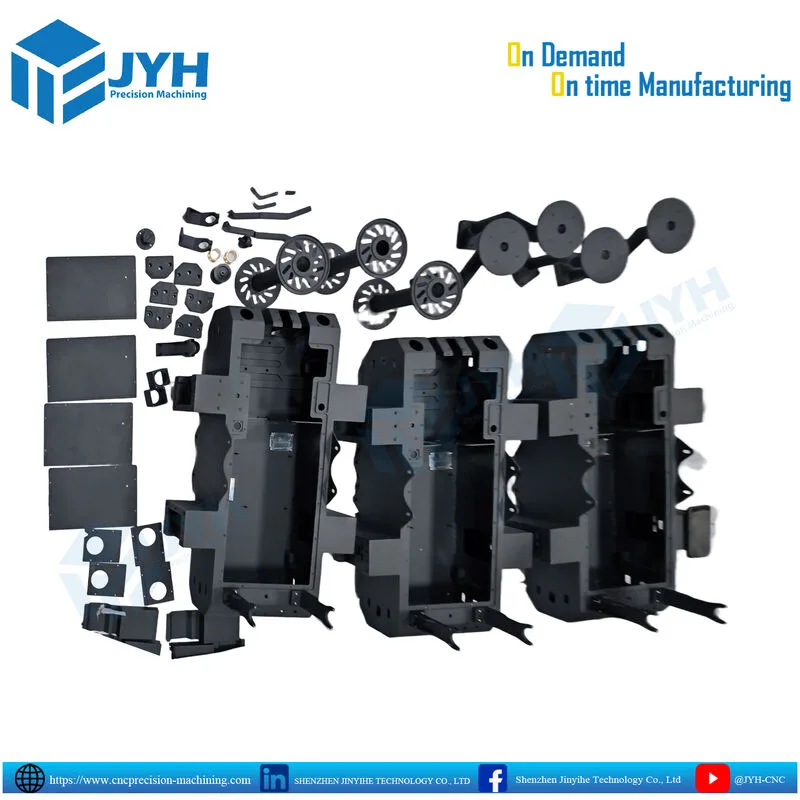
What Is a Turnkey Mechanical Sub-Assembly?
A turnkey mechanical sub-assembly is a complete, pre-fitted kit of mating components — chassis frames, mounting brackets, drive shafts and cover plates — machined, finished and trial-assembled by one manufacturer, so the parts arrive ready to drop into your final machine.
It is designed for pick-and-place systems, automated sorting lines, semiconductor handling modules and industrial robotic equipment. Sourcing the same parts piecemeal from separate suppliers risks tolerance stack-up and alignment mismatch at final assembly; a turnkey kit removes that risk because every interface is machined and verified under one roof.
Bill of Materials & Process Breakdown
Every component family in the kit is produced with the process and material best suited to its function:
| Sub-Assembly Component | Manufacturing Process | Primary Material | Key Functional Features |
|---|---|---|---|
| Main Chassis / Enclosure Blocks | 4-Axis & 5-Axis CNC Milling | AL6061-T6 / AL7075 | Deep-cavity pocketing, dowel-pin locating bores, tapped mounting grids |
| Flanged Drive Shafts & Pulleys | CNC Turning + Multi-Axis Live Tooling | 40Cr / 304 Stainless Steel | Spoke-lightened wheel hubs, concentric bearing journals, keyway slots |
| Rotary Linkages & Lever Arms | CNC 3-Axis Contour Milling | AL6082-T6 | High-stiffness link bars, reamed pivot pin bores for smooth rotation |
| Enclosure Covers & Baffles | Fiber Laser Cutting + CNC Press Brake Bending | 5052-H32 Sheet Metal | Precision deburred edges, countersunk fastener patterns, flush-fit fitment |
| Mounting Brackets & Shims | Wire EDM + High-Speed CNC Milling | Q235B / 6061-T6 | Slotted alignment holes for adjustability, ground planar faces |
Turnkey Kit vs. Piecemeal Sourcing
Managing individual part orders across multiple suppliers compounds quality and logistics risk. A single-source kit changes the picture on every metric that matters:
| Evaluation Metric | Fragmented Piecemeal Sourcing | Turnkey Kit with Pre-Fit Assembly |
|---|---|---|
| Tolerance stack-up risk | High — varied supplier measuring standards cause fitment binding | Virtually zero — verified through trial sub-assembly fitting before shipment |
| Surface finish consistency | Color and gloss discrepancies across different anodizing baths | Batch-processed treatments for a uniform satin black anodized finish |
| Project lead time | Delayed by the slowest supplier; multiple shipping pipelines | Synchronized scheduling; complete kit delivered in a single shipment |
| Inspection & traceability | High internal QC overhead checking hundreds of separate parts | Unified first-article inspection (FAI) and consolidated CMM report |
| Production risk & cost | Extra scrap and rework when parts fail to mate on site | Guaranteed interface alignment; pre-tapped holes and dowel pins 100% verified |
Engineering Highlights
- Precision alignment & concentricity — critical bearing seats, linear guide mount surfaces and gear shafts machined to H7 tolerance standards for smooth kinematic motion and low backlash under cyclic dynamic loads.
- Coordinated tolerancing across interfaces — mating features between milled structural blocks and sheet metal covers are dimensioned for flush interfaces without thermal distortion or clearance gaps.
- Surface protection & durability — aluminum components receive Type II black anodizing (MIL-A-8625) or hard anodizing; steel shafts and hardware receive black oxide or electroless nickel plating.
- Structural weight optimization — CNC pocketing on chassis blocks and spoke cutouts on rotary flanges strip inertial weight without compromising torsional rigidity.
Typical Industry Applications
- Automated packaging & sorting lines — heavy-duty actuator brackets, frame mounts and synchronized timing components.
- Semiconductor & electronics assembly — precision indexing stations, wafer-handling bracketry and cleanroom test fixtures.
- Robotics & factory automation — multi-axis gantry frames, end-of-arm tooling (EOAT) mounting brackets and motor transfer modules.
- Medical device production machinery — vibration-isolated chassis housings and sterile diagnostic processing enclosures.