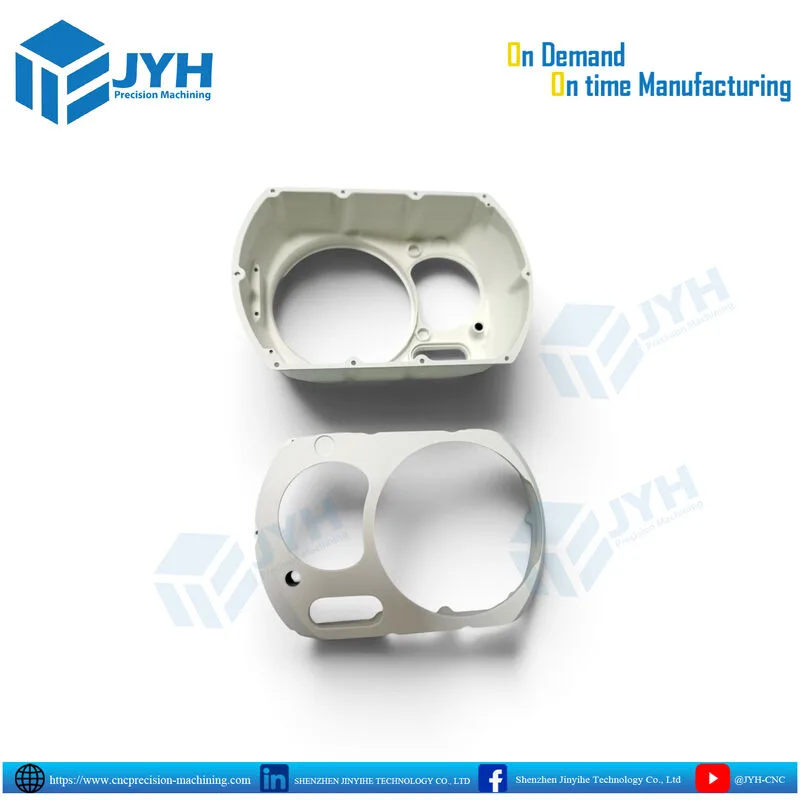
Built for Payload-Sensitive Electro-Optical Systems
This dual-aperture magnesium housing is engineered for payload-sensitive aerospace gimbals, multi-spectral drone cameras, LiDAR sensor suites and tactical optical devices, and demonstrates advanced thin-wall multi-axis CNC machining paired with high-performance ceramic passivation.
Magnesium's ultra-low density (1.78 g/cm³) delivers a 34% weight reduction compared with aluminum 6061 and an inherent vibration damping factor around 50× that of standard structural metals — shielding sensitive electro-optical sensors against dynamic operating shock while stripping critical payload mass. Multi-axis high-speed milling and precision boring achieve uniform thin walls down to 1.0 mm and optical bore concentricity of ±0.010 mm.
Technical Specifications & Engineering Tolerances
| Parameter | Specification Standard |
|---|---|
| Component Type | Dual-Aperture Optical Front Bezel / Sensor Enclosure Housing |
| Material Options | AZ91D / AM60B (die-casting + CNC finishing) or AZ31B / ZK60 (billet CNC milling) |
| Wall Thickness | Uniform thin-wall sections: 1.0 mm–1.5 mm with reinforced internal flange ribs |
| Dimensional Accuracy | Optical bore diameters: ±0.010 mm; general profile: ±0.025 mm |
| Geometric Tolerances | Dual-bore concentricity within 0.012 mm; front-to-back parallelism within 0.015 mm |
| Surface Finish (Ra) | As-machined Ra 0.8 μm; post-coating smooth matte aesthetic finish |
| Surface Passivation | Micro-Arc Oxidation (MAO / PEO) matte white ceramic conversion + sealed protective topcoat |
| Fastening Protection | Precision tapped blind holes with stainless steel micro Helicoil inserts |
Magnesium vs. Aluminum vs. Carbon Fiber
For optical housings, magnesium offers an optimal balance of structural stiffness, thermal management and weight:
| Engineering Metric | Magnesium Alloy (AZ91D / AZ31B) | Aluminum Alloy (6061-T6) | Molded Carbon Fiber (CFRP) |
|---|---|---|---|
| Density (g/cm³) | 1.78 — lightest structural metal | 2.70 (+51% heavier) | 1.55 (slightly lighter) |
| Thermal Dissipation | High (51–96 W/m·K) — cools internal electronics | Highest (167 W/m·K) | Extremely low (1–5 W/m·K) — insulates heat |
| EMI / RFI Shielding | Inherent 360° Faraday cage protection | Full metal cage shielding | Requires secondary conductive paint |
| Vibration Damping | Exceptional (SDC ≈20%–40%) | Low (SDC <2%) | Moderate (resin dependent) |
| Complex Geometry Precision | True CNC machined circularity and threads | Excellent | Difficult for tight-tolerance bores |
| Thermal Expansion Match | Matches common optical glass carriers | Moderate (23 μm/m·K) | Anisotropic (mismatched expansion) |
Key Manufacturing & Design Advantages
- Dual-aperture coaxial precision — both the primary lens barrel aperture and the auxiliary sensor window are profiled in a single setup, guaranteeing axis alignment and zero optical parallax error.
- Micro-Arc Oxidation (MAO/PEO) finish — a dense ceramic-grade coating with 500+ hours of neutral salt-spray corrosion protection, surface hardness above 400 HV and solar thermal reflectance for airborne environments.
- Internal structural flanging — circumferential stiffening bosses and O-ring sealing grooves allow IP67 environmental sealing without wall distortion under screw torque.
- EMI/RFI enclosure integrity — the monolithic magnesium body acts as a continuous electromagnetic shield for sensitive imaging sensors.
Primary Industry Applications
- Aerospace & UAV gimbals — dual-sensor payloads combining electro-optical (EO) zoom lenses and infrared (IR) thermal sensors.
- Autonomous mobile robots (AMR) — LiDAR, depth camera and ultrasonic sensor mounting frames in high-vibration factory environments.
- Tactical electro-optics — ruggedized rangefinders, night-vision monocular housings and soldier-worn optoelectronic enclosures.
- Precision inspection systems — machine vision cameras on rapid-cycling pick-and-place gantry heads where low inertial mass improves cycle speed.