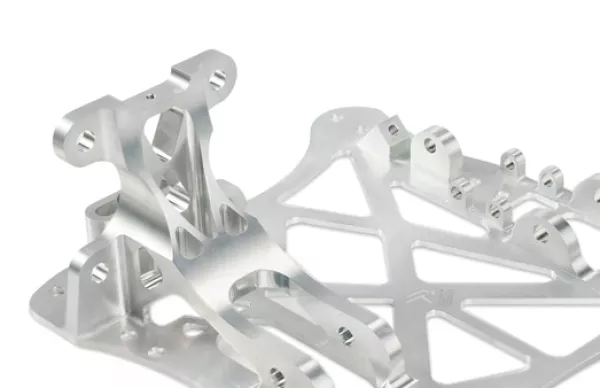
The challenge. A structural bracket for aerospace and robotics assemblies needed webs under 1.0 mm thick, multi-plane mounting flanges and weight-reduction cutouts, machined from 6061-T6/7075-T6 billet. Parts this thin fight back: cutting forces make them chatter, and removing that much material releases internal stress that twists the part after unclamping.
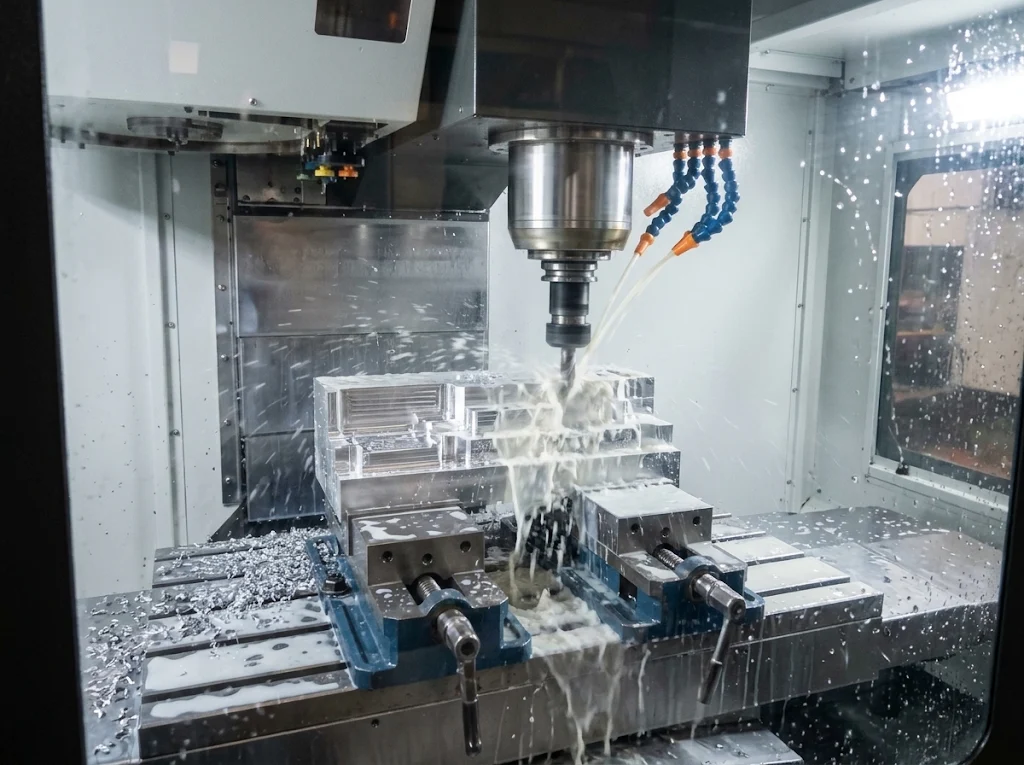
Our approach. The CAM strategy used high-speed machining with shallow depths of cut and light radial step-overs to keep cutting forces low. A dedicated vacuum fixture with profile-matching soft jaws supported the thin webs uniformly during finishing, and roughing was split into stages with stress-relief resting periods before the final skim cuts.
Finishing and inspection. Parts were micro-bead blasted for a uniform surface, then matte black anodized (Type II) with threads and holes protected. The Zeiss CMM verified profile position and planarity across all mounting faces, backed by optical comparator checks of the thin-wall sections.
The result. Flatness and parallelism held within ±0.015 mm across the primary faces, every threaded feature passed gauge inspection, and the brackets arrived ready to drop into the customer’s assembly with zero rework.